

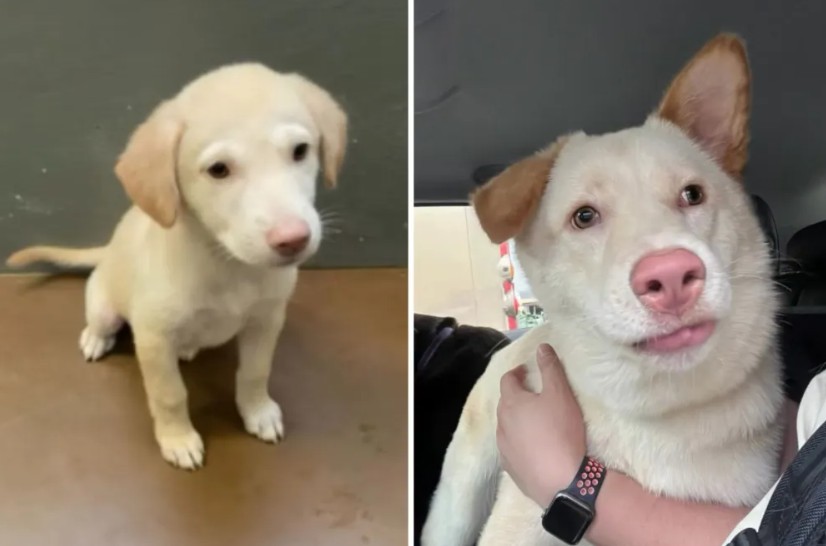
A couple thought they were adopting a sweet little Labrador-looking puppy from a shelter. Then she started growing up, and things got hilariously confusing.
The owners shared Buffy’s original animal shelter listing in a June 5 Instagram post on the account @buffy.the.egg.slayer. At the time, the tiny pup had a short, light brown coat and floppy ears, giving her the look of a classic Lab puppy.
That was enough to win them over.
But as Buffy grew, her appearance began to change in ways her owners definitely did not expect.
Her once-floppy ears started doing their own thing, with photos showing at least one ear standing straight up. That is not exactly the first trait most people picture when they think “Labrador retriever.”
Then there was her pink nose, another feature that made her look less and less like the dog breed her owners thought they were getting. Labradors can vary in color, but breed standards typically describe them as having black or brown noses.
The owners summed up the surprise perfectly in the caption: “Safe to say she wasn’t a Lab…”
Looking back, there may have been a clue all along. Buffy’s shelter listing did not actually call her a Labrador. It listed her as a “mongrel,” a general term often used for mixed-breed dogs or dogs with unknown ancestry.
Still, when her owners saw that adorable puppy face, they made their best guess based on looks alone.
Now that Buffy is fully grown, it is clear she is not the Lab-like dog they expected. But her family could not be happier with how things turned out.
The text on the clip said it all: “Wouldn’t change a thing.”
WATCH THE VIDEO BELOW:
Buffy’s transformation has amused plenty of dog lovers online, especially those who know how unpredictable shelter puppies can be. A puppy’s ears, body shape, coat and overall look can change dramatically during the first year, making breed guesses tricky even for experienced dog people.
The American Kennel Club notes that many breed-specific traits do not fully appear until a dog reaches adolescence or adulthood. That means a shelter puppy who looks one way at a few weeks old may grow into a dog who looks completely different.
Research has also shown that visual breed identification is often unreliable, especially for shelter dogs with mixed backgrounds. A 2018 study published in PLOS ONE looked at more than 900 shelter dogs in Arizona and California and found that many had complex ancestry that did not match simple visual guesses.
In other words, Buffy’s owners are far from alone.
Shelter staff, vets and adopters often make their best estimate based on what they can see, but mixed-breed dogs can surprise everyone.
And Buffy may be the perfect example. She may not have grown into the Labrador her owners expected, but she grew into something even better — a one-of-a-kind dog they clearly adore.
 What's Up Today Editorial Team