

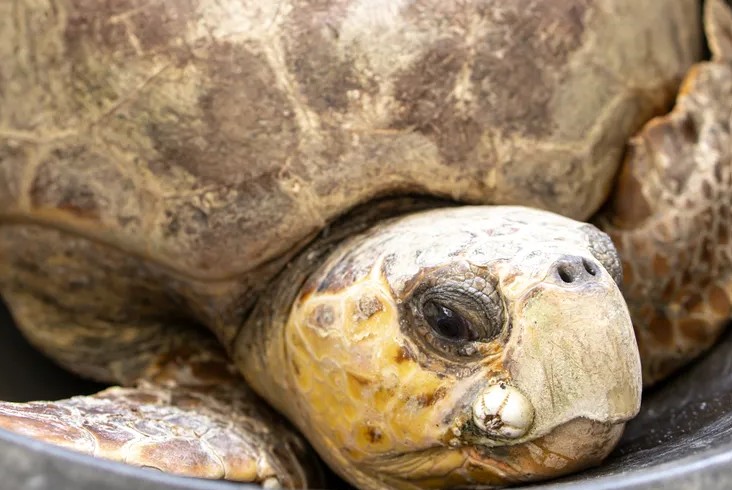
A massive loggerhead sea turtle was rescued in dramatic fashion after getting hooked near a Florida fishing pier and lifted about 35 feet above the Gulf of Mexico.
The turtle, a 172-pound male later named Bowser, was rescued on Sunday, June 7, after he was foul-hooked near his left front flipper by a fisherman casting from the Navarre Beach Fishing Pier, according to Inside Climate News.
Within 25 minutes, volunteers from the Navarre Beach Sea Turtle Conservation Center moved into action. Eight men gripped a rope and helped hoist Bowser from the water using a rescue net, lifting the giant turtle from the Gulf and over the pier railing.
Bowser was then loaded onto a Kawasaki UTV and taken to the rescue facility. On the way, he thrashed around — which rescuers said was actually a good sign.
“That’s a good sign,” volunteer Cheri Dexter said. “If they’re lethargic or just lying there, that’s a bad sign.”
Bowser was the 26th turtle rescued from the Navarre Beach pier so far in 2026. Just two days later, another turtle became the 27th.
The problem is not new. In 2025, the center rescued 59 turtles from the same stretch of water, mostly loggerheads and green sea turtles during Florida’s nesting season, which runs from May through October.
Navarre Beach Fishing Pier is the longest pier in Florida, stretching 1,545 feet into the Gulf. That makes it a popular fishing spot, but also one of the most active locations in the state for sea turtle entanglements.
From 2000 to 2022, Santa Rosa County, where Navarre Beach is located, accounted for 56% of fishing pier entanglements reported along Florida’s Gulf Coast, according to a study by researchers with the Florida Fish and Wildlife Conservation Commission.
Cheri and Scott Dexter lead a team of 26 FWC-certified volunteers who rescue turtles and transport them to approved rehabilitation centers. Scott also designed and built the special hoist system used to lift injured or hooked turtles safely over the pier railing.
Volunteers rotate between morning and evening shifts, when sea turtles are most active.
After his rescue, Bowser was transferred to the Gulfarium CARE Center in Fort Walton Beach. There, staff removed the fishing hook from his left front flipper and another hook lodged in his esophagus.
X-rays then revealed a third hook, also in his esophagus, likely from a previous encounter. Staff said Bowser would need a separate sedated procedure to remove that hook manually.
Mary Fomby with Gulfarium explained that the team also uses a less invasive treatment involving cotton balls soaked in mineral oil.
“We’ll actually do something where we feed them, along with their normal fish, cotton balls that have mineral oil on them,” Fomby said.
The goal is for the cotton to catch on the hook and create a barrier around the sharp tip, helping prevent it from latching onto other parts of the turtle’s intestines.
Fomby said the Gulfarium team is currently treating 31 turtles from across the Florida Panhandle and neighboring states, including Alabama.
According to the National Park Service, all five sea turtle species found in the Gulf are listed as endangered or threatened under the Endangered Species Act.
Fishing line and hooks are not the only dangers these animals face. Sea turtles are also threatened by boat strikes, habitat loss and climate change.
Valerie Nicole Tovar, conservation manager for the Loggerhead Marinelife Center, said rising temperatures are an especially serious concern in Florida.
“Especially here in Florida, the concern is that our beaches are so hot that we might be producing more females than we are males, and that could affect the population overall,” Tovar said.